
In response to the escalating Middle East situation’s impact on the global economy, particularly energy costs and supply chain stability, the Singapore government today announced an additional S$1 billion (approximately US$740 million) support package. The core of this package lies in a series of robust financial measures designed to comprehensively assist local enterprises, especially affected transport operators and energy-intensive industries, to enhance their resilience and ensure continued economic stability.
Macroeconomic Challenges and Government Response Strategy
Singapore’s Deputy Prime Minister and Minister for Trade and Industry Gan Kim Yong, Acting Minister for Transport and Senior Minister of State for Finance Chee Hong Tat, and Coordinating Minister for National Security and Minister for Home Affairs K Shanmugam delivered statements in Parliament, emphasizing the government’s strategy of a “whole-of-government” approach to actively address external challenges. Prime Minister Lawrence Wong also reiterated on social media that Singapore would “make decisive decisions” and “stand together with businesses to overcome this difficult period” .Minister Gan Kim Yong noted that the Middle East conflict has led to a surge in global energy prices, posing significant inflationary pressure on Singapore, a highly open economy. The Monetary Authority of Singapore (MAS) is expected to release its latest inflation assessment data on April 14, while the Ministry of Trade and Industry (MTI) will update its Gross Domestic Product (GDP) forecast in May, currently projected to be in the range of 2% to 4% .
Against this backdrop, the government’s support package aims to provide crucial assistance to businesses, helping them absorb rising operating costs and encouraging them to leverage the current environment for transformation and upgrading to enhance long-term competitiveness. Minister Chee Hong Tat explicitly stated: “The government will not stand idly by. We will introduce further support measures building on the Budget measures.”
Core Measures of the Enterprise Support Package
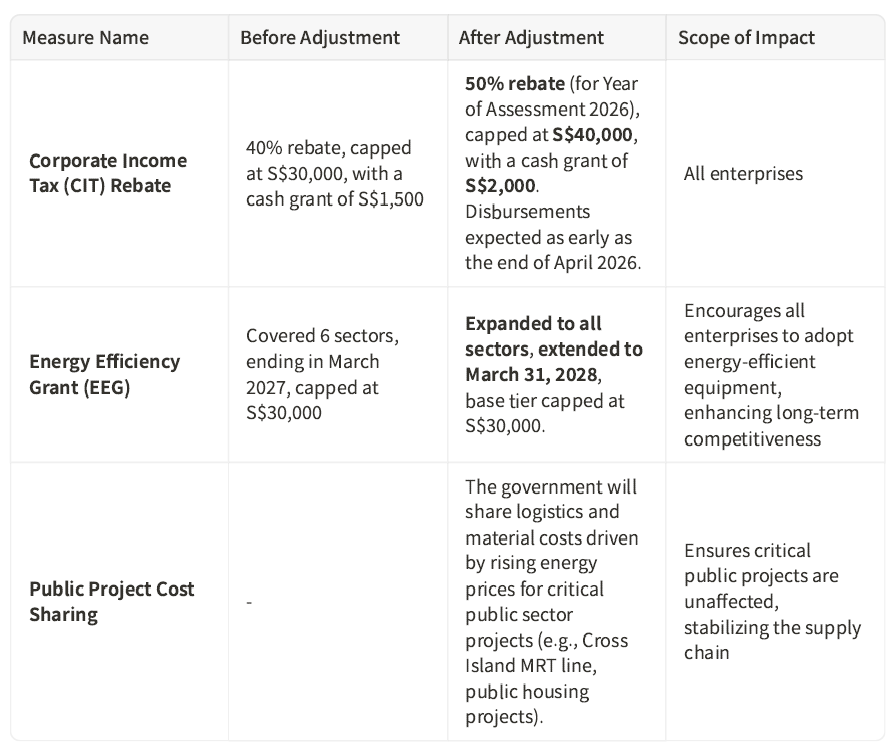
Among the nearly S$1 billion support package, multiple measures directly target businesses, aiming to alleviate their financial burden, encourage energy-saving transitions, and safeguard employment. Minister Gan Kim Yong specifically highlighted that the Middle East situation would affect the energy and chemical sectors, energy-intensive industries, outward-oriented sectors like aviation and maritime, as well as inward-oriented sectors such as retail and food. Therefore, the government’s aid measures are highly targeted, designed to help these affected industries tide over the difficult period.
Targeted Industry and Group Assistance
In addition to broad-based enterprise measures, the government has provided targeted support for the most directly affected industries and groups:
- Transport and Platform Workers: A cash payout of S$200 will be disbursed to active platform workers (including food delivery riders, private-hire car drivers, and taxi drivers), expected to begin at the end of April .
- Essential Bus Services: Funding will be provided for essential bus services catering to students, seniors, and persons with disabilities to offset rising operating costs and ensure services continue without disruption .
Household and Employee Support
To alleviate the cost-of-living pressures on the public, the government has also introduced assistance measures for households and employees:
- CDC Vouchers: The S$500 CDC vouchers originally scheduled for distribution in January 2027 will be brought forward to June 2026 .
- Cost-of-Living (COL) Special Payment: An additional S$200 will be provided, bringing the total payout to between S$400 and S$600, expected to be disbursed in September 2026, benefiting approximately 2.4 million Singaporeans .
Amidst the current turbulent external environment, the Singapore government has once again demonstrated its “forward-looking” governance style. This nearly S$1 billion support package is not only a “timely rain” for businesses and households but also a shot in the arm for the local business environment. Whether it is the enhancement of tax rebates or the expansion of energy efficiency grants, it reflects the government’s determination to overcome difficulties together with businesses. Through targeted measures and cross-ministerial collaboration, Singapore aims to address short-term shocks while laying the foundation for the long-term resilience and transformation of its economy.
References
- Lianhe Zaobao. (April 7, 2026). Government rolls out nearly $1 billion package to cushion impact of Middle East situation on Singaporeans.
- The Business Times. (April 7, 2026). Singapore rolls out S$1 billion support package as energy costs rise, expands corporate tax rebates and payouts.

