
Singapore’s public transport network has reached a significant milestone.
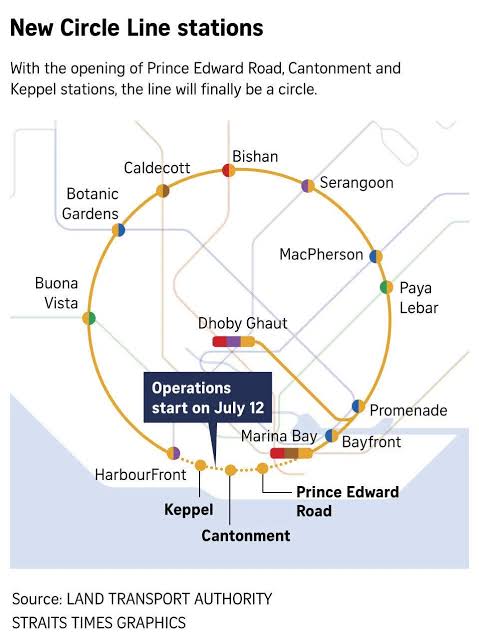
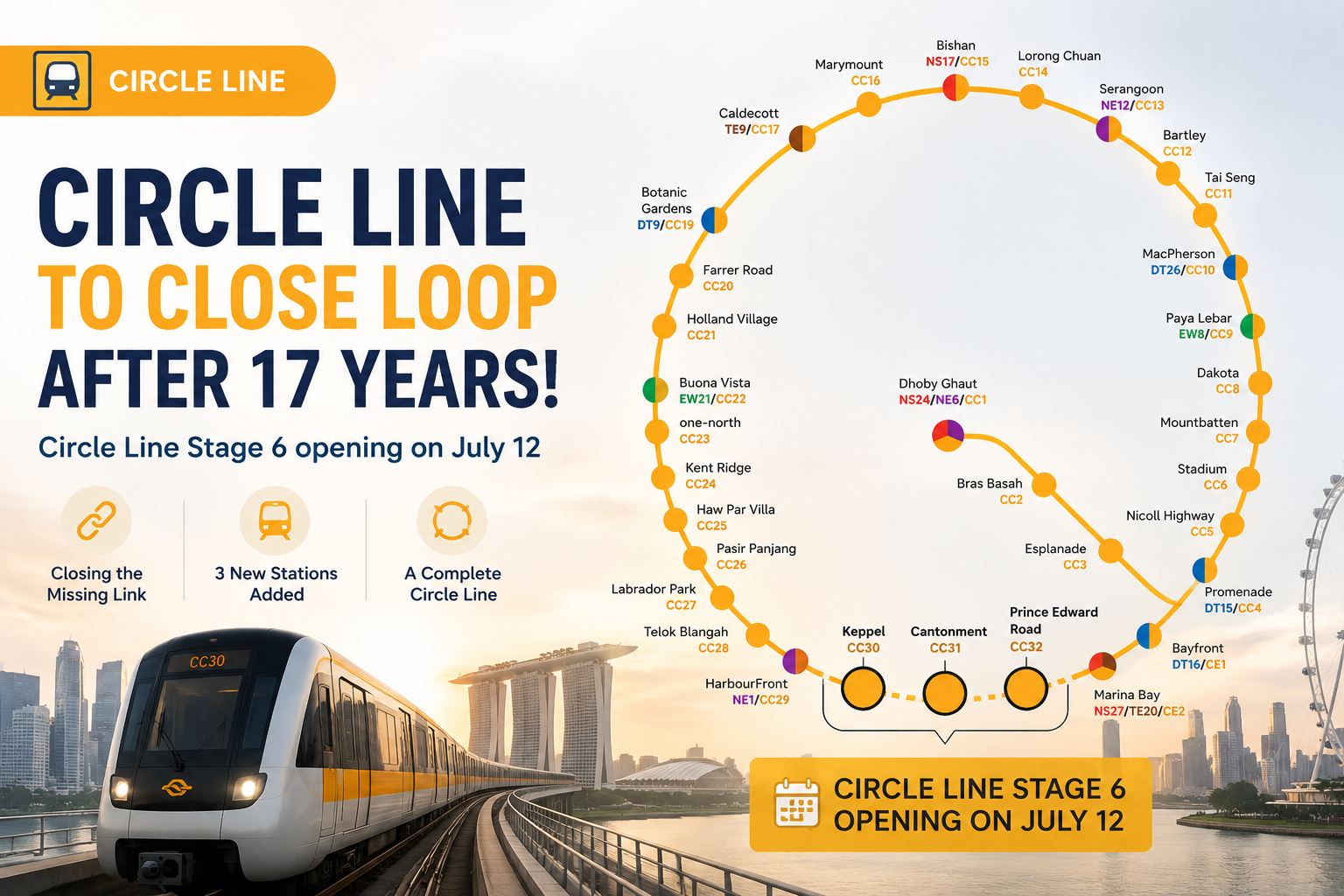
Circle Line Stage 6, commonly known as CCL6, officially commenced passenger service on 12 July 2026. With the opening of Keppel, Cantonment and Prince Edward Road MRT stations, the previously unconnected section between HarbourFront and Marina Bay has been completed, turning the Circle Line into a full loop.
The completed line provides commuters with more direct access between southern Singapore, the Central Business District and other major residential and commercial areas.
Key Facts About Circle Line Stage 6
Circle Line Stage 6 connects HarbourFront MRT station to Marina Bay MRT station through three new stations:
- CC30 Keppel
- CC31 Cantonment
- CC32 Prince Edward Road
With the completion of CCL6, the Circle Line now spans approximately 39 kilometres and comprises 33 stations, including 12 interchange stations connecting commuters to Singapore’s existing MRT lines.
To support the expected increase in passenger demand, 23 additional Circle Line trains were purchased, with the first trains progressively entering service from April 2026.
What Areas Do the Three New Stations Serve?
CC30 Keppel
Keppel station is situated along Keppel Road and serves the Keppel Harbour, logistics, commercial and employment areas nearby.
As southern Singapore continues to develop, the station is expected to become an important transport connection between HarbourFront, the Central Business District and the future Greater Southern Waterfront.
CC31 Cantonment
Cantonment station is located near the former Tanjong Pagar Railway Station.
Elements of the area’s railway heritage have been reflected in the station’s architecture and design. The station improves access for residents and workers in Cantonment, Spottiswoode Park, Tanjong Pagar and the surrounding neighbourhoods.
It will also support future developments within the Greater Southern Waterfront.
CC32 Prince Edward Road
Prince Edward Road station is located near Shenton Way, Tanjong Pagar and the Marina Bay business district.
The station provides workers and visitors with another convenient route into the Central Business District while improving connectivity between Marina Bay, Keppel and HarbourFront.
How Will the Completed Circle Line Improve Commuting?
1. Direct Connection Between HarbourFront and Marina Bay
Before the opening of CCL6, passengers travelling between HarbourFront and Marina Bay might have needed to transfer to another MRT line.
Commuters can now travel directly along the following section:
HarbourFront → Keppel → Cantonment → Prince Edward Road → Marina Bay
This creates a more convenient connection between the southern waterfront areas and the city centre.
2. More Alternatives to Busy Interchanges
The completed Circle Line gives passengers more route options that may allow them to bypass heavily used interchanges such as City Hall and Raffles Place for certain journeys.
Providing more alternative routes can also help distribute passenger traffic more evenly across Singapore’s rail network.
3. Improved Access to Southern Singapore
Commuters living or working along the Circle Line can now reach Keppel, Cantonment, Shenton Way, Marina Bay and HarbourFront more directly.
This is especially beneficial for employees travelling to offices, logistics facilities, port-related businesses and other workplaces in southern Singapore.
4. A More Resilient Rail Network
A completed loop strengthens overall rail connectivity and gives commuters more travel alternatives during congestion or service adjustments on other parts of the MRT network.
What Does CCL6 Mean for Businesses?
Circle Line Stage 6 is not only a transport infrastructure project. It may also have a long-term impact on businesses and commercial activity in southern Singapore.
Better Accessibility for Offices
Companies based in Keppel, Tanjong Pagar, Shenton Way and Marina Bay will become more accessible to employees, clients and business partners travelling from different parts of Singapore.
Improved transport connectivity may also allow employers to recruit from a wider geographical area.
Supporting the Greater Southern Waterfront
The Keppel and Cantonment areas form part of Singapore’s broader Greater Southern Waterfront plans.
The new MRT stations will provide essential transport infrastructure for future residential, office, commercial and recreational developments in the area.
As these districts are progressively developed, businesses may see new opportunities arising from growing demand for professional, retail, hospitality and supporting services.
Stronger Connections to the Central Business District
Prince Edward Road station strengthens the connection between Shenton Way, Marina Bay and other locations along the Circle Line.
For companies whose employees frequently travel to client offices, banks, professional service firms, government agencies or meeting venues in the CBD, the new route may help reduce the inconvenience associated with multiple transfers.
What Should Commuters Take Note Of?
With the Circle Line operating as a complete loop, its wayfinding system differs from that of a conventional end-to-end MRT line.
Passengers should check the following information before boarding:
- Clockwise Loop
- Anticlockwise Loop
- The stations shown on platform and train displays
- The service pattern when travelling to stations located on the Circle Line spur
As the Circle Line is Singapore’s first full-loop MRT service, commuters are encouraged to select their platform according to the stations the train will pass rather than relying only on a traditional terminal station name.
The opening of Circle Line Stage 6 marks the completion of Singapore’s Circle Line.
Keppel, Cantonment and Prince Edward Road stations do more than close the physical gap between HarbourFront and Marina Bay. They improve connections among southern Singapore, the Central Business District and major residential and employment areas across the island.
Over the longer term, the completed Circle Line is expected to support more convenient commuting, better business accessibility and the continued development of the Greater Southern Waterfront.
For businesses, this expansion may create new possibilities in office location planning, workforce mobility, customer accessibility and future commercial development.
Reference
- Land Transport Authority. (May 14, 2026). Circle Line Stage 6 to Open for Public Preview on 4 July 2026. https://www.lta.gov.sg/content/ltagov/en/newsroom/2026/5/news-releases/circle-line-stage-6-to-open-for-public-preview-on-4-july-2026.html
- Land Transport Authority. (n.d.). Circle Line 6. https://www.lta.gov.sg/content/ltagov/en/upcoming_projects/rail_expansion/circle_line_6.html
- Land Transport Authority. (June 24, 2026). Explore Three New Circle Line Stage 6 Stations on 4 July 2026. https://www.lta.gov.sg/content/ltagov/en/newsroom/2026/6/news-releases/explore-three-new-circle-line-stage-6-stations-on-4-july-2026.html
- Land Transport Authority. (n.d.). Circle Line. https://www.lta.gov.sg/content/ltagov/en/getting_around/public_transport/rail_network/circle_line.html
- Land Transport Authority. (January 12, 2022). Factsheet: Completion of Circle Line 6 Tunnelling Works. https://www.lta.gov.sg/content/ltagov/en/newsroom/2022/1/news-releases/Completion_CCL6_tunnelling_works.html
- Urban Redevelopment Authority. (June 2, 2026). Vibrant City Living for All: Greater Southern Waterfront. https://www.ura.gov.sg/land-planning/master-plan/master-plan-2025/regional-plans/central-region/vibrant-city-living-for-all/

